
[Recommended Sharpening Stones for Japanese Kitchen Knives] Beginner's Guide to Sharpening | How to Choose and Combine Grit Sizes
For beginners learning to sharpen Japanese kitchen knives, the basic approach is to use a 1000-grit medium whetstone as the base, combine it with a 400-grit coarse whetstone for chipping, and a 3000-6000 grit finishing whetstone for improving sharpness. Especially for first-timers, a double-sided whetstone with 1000-grit and 3000-6000 grit whetstones is cost-effective and easy to use, and is sufficient for maintaining Japanese kitchen knives at home.
The best whetstones for Japanese knives: The conclusion for choosing the right whetstone for knives is a simple combination: "Use a 1000-grit medium whetstone as a base, and add coarse and fine whetstones depending on the condition of your Japanese knife."
[Key points of this article]
If you're going to sharpen a Japanese kitchen knife, the basic first thing you should do is get a 1000-grit whetstone.
It's important to understand the role of each grit size: "Around 400 grit is for repairing chips," and "3000 to 6000 grit is for improving sharpness."
Beginners are less likely to make mistakes if they use a double-sided whetstone set designed for Japanese knives, along with a whetstone holder and flattening stone.
Today's review: 3 key points
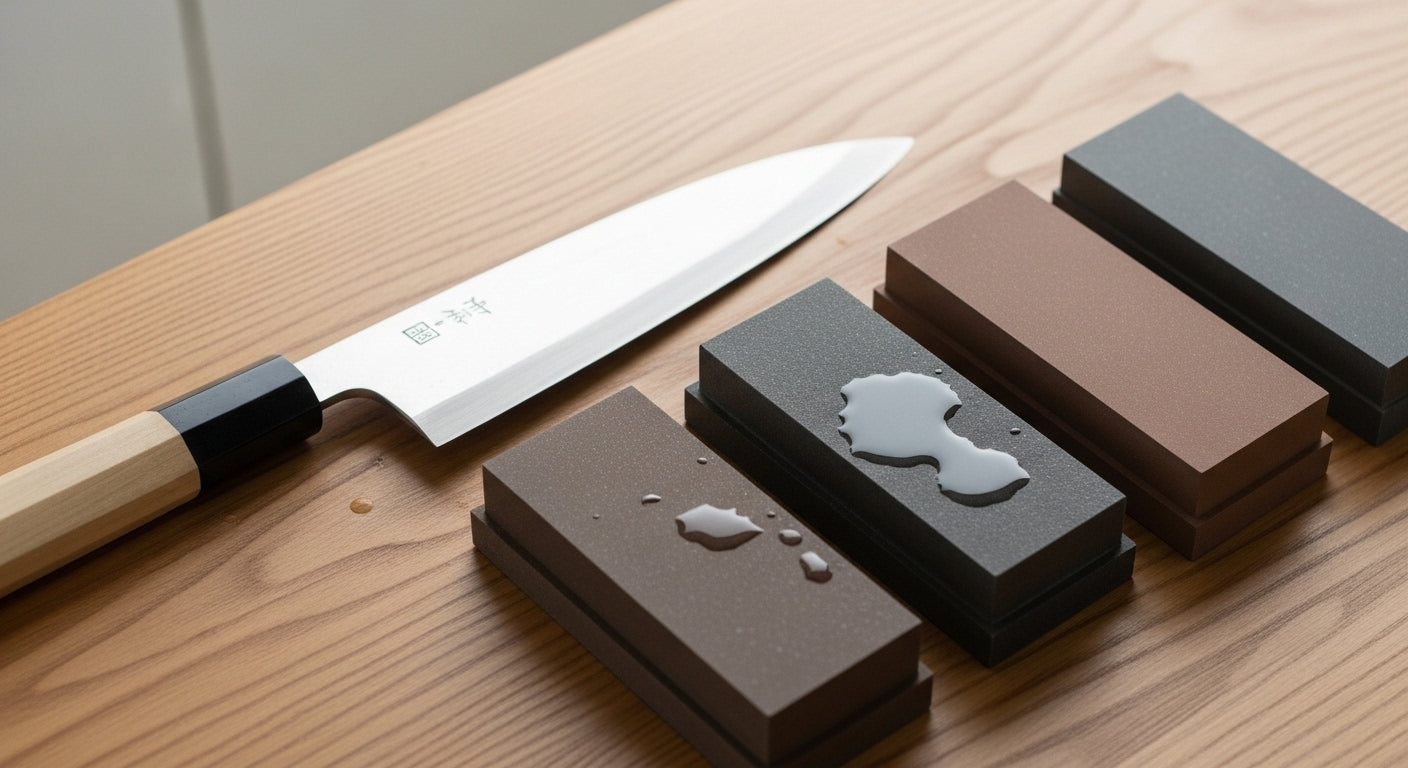
For Japanese kitchen knives, a three-tiered system of whetstones—coarse, medium, and fine—is ideal.
The first thing you should buy is a combination whetstone set: a 1000-grit medium-grit whetstone for knives and a 3000-6000 grit finishing whetstone.
When choosing a whetstone for Japanese knives, it's important to consider not only the grit size but also the appropriate hardness, size, and whether or not it comes with a whetstone holder.
Conclusion of this article
In short, the recommended whetstone for Japanese knives is a double-sided whetstone with a 1000-grit medium grit stone and a 3000-6000 grit finishing stone, with a coarse grit stone of around 400 added as needed.
The three things beginners should keep in mind are: "Start with a medium-grit whetstone," "Use the whetstones in order from smallest grit to largest," and "Choose a size and hardness that suits your Japanese kitchen knife."
If you want to maintain the sharpness of your Japanese kitchen knife for a long time, it's recommended to get a set of a home-sized artificial whetstone, a flattening stone, and a whetstone stand.
Recommended Sharpening Stones for Japanese Kitchen Knives: What are the Basics for Sharpening Knives? (Optimal Grit Configuration for Japanese Kitchen Knives)
In conclusion, when sharpening Japanese knives, the most important thing is to be mindful of a three-part system: "coarse whetstone 220-400 grit, medium whetstone 800-1200 grit, and finishing whetstone 3000-6000 grit." The reason is that each grit has a clearly defined role, allowing for consistent control from repairing chips to achieving a smooth finish. Specifically, the idea is to use only the medium whetstone for everyday sharpening, use the coarse whetstone only when there is a chip, and use the finishing whetstone for the final touch on delicate Japanese knives such as those used for sashimi.
The grit number of a whetstone indicates its strength; the smaller the number, the stronger its abrasive power. Conversely, the higher the grit number, the finer the abrasive particles, making it suitable for finishing and smoothing the blade surface. Keeping this basic principle in mind will make it easier to determine which grit to use and when. Due to their structure, Japanese knives often require sharpening that is close to single-edged blades, so being more aware of the role of each grit and using them accordingly is directly related to maintaining sharpness.
How to choose the right grit whetstone for Japanese knives
In conclusion, for Japanese kitchen knives, choosing a single whetstone with a grit of around 1000 will cover most household uses. A grit of 1000 is widely used by both professionals and home users as a "standard whetstone" to restore lost sharpness, and it is easy to use for both Japanese and Western knives. For example, knife manufacturers such as Jikko Cutlery and Kai Corporation position the 1000 grit whetstone as "the first whetstone you should acquire," and many easy-to-use home models with stands are available at home improvement stores.
When choosing a whetstone, it's important to pay attention not only to the grit number but also to the stone's "hardness" and "size." Harder whetstones wear down less and last longer, but they may cause some Japanese knife blades to catch on the stone. On the other hand, slightly softer whetstones produce a lot of slurry and are easy to use, but they wear out faster. For home use, a medium-hard to medium-hardness synthetic whetstone is easy to handle and suitable for beginners. A home whetstone size of about 18-21cm in length is just right for common Japanese knives such as santoku knives and deba knives.
When do you need a coarse whetstone and a fine whetstone?
In short, you'll need a coarse whetstone if your blade is chipped, and a fine whetstone if you're particular about sashimi or thin slicing. Coarse whetstones (220-400 grit) are suitable for "shaving work" such as removing rust, repairing large chips, and changing the blade shape, and can reset the blade to a state that a medium whetstone can't handle. On the other hand, fine whetstones (3000-6000 grit) are suitable for achieving the sharp cutting edge and beautiful cross-section of food that are characteristic of Japanese knives, and high-grit fine whetstones are recommended for blades used for sashimi, such as yanagiba knives.
A coarse whetstone is necessary when the blade has obvious chips or deformation, or when sharpening a knife that hasn't been sharpened for a long time. In these situations, starting with a medium whetstone would take too long, so it's more efficient to roughly shape the blade with a coarse whetstone before moving on to a medium whetstone. On the other hand, a finishing whetstone doesn't need to be used every time, but it's most effective when used before cooking situations where sharpness is particularly important (such as slicing sashimi or thinly slicing vegetables).
Which is better suited for Japanese knives: natural or artificial whetstones?
In conclusion, for those just starting out sharpening Japanese knives, it's practical to begin with artificial whetstones (synthetic whetstones). This is because artificial whetstones have clear grit markings, provide consistent sharpening results, and are more affordable than natural whetstones, making them suitable for beginners learning grit combinations. On the other hand, advanced users who want to stick to traditional Japanese knives can combine them with natural whetstones (equivalent to #6000 to #10000) as a finishing stone, which has the advantage of creating a smoother blade that releases food more easily.
Natural whetstones vary greatly in sharpening performance depending on their origin and the properties of the stone. While there's the enjoyment of "finding the stone that suits your knife," they are difficult to handle and tend to be expensive. Synthetic whetstones offer consistent quality and make it easier to objectively assess your sharpening progress, making them ideal as a first step in mastering basic sharpening techniques. For beginners, the fastest way to improve, though it may seem like a roundabout approach, is to first learn the correct sharpening angle and pressure with a synthetic whetstone, and then try a natural whetstone once you can consistently achieve a sharp edge.
Recommended whetstones for Japanese kitchen knives: How to choose and combine them?
In conclusion, the key to choosing the right whetstone for Japanese knives is to match the grit size and type of whetstone to the number of knives you own and their intended use. The simplest option is for home use, where you use several knives such as santoku, ko-deba, and petty knives. A single combination whetstone with a 1000 grit medium stone and a 3000-6000 grit finishing stone on both sides is ideal. For those who use knives in a more professional manner, or who use long Japanese knives such as sashimi knives, a wide, three-piece whetstone with grits ranging from coarse to fine is more suitable.
Another often overlooked aspect when choosing a whetstone is whether or not it comes with a whetstone stand. A whetstone stand stabilizes the whetstone while sharpening, making it less likely to apply excessive force. Especially for beginners, a whetstone stand makes it easier to maintain a consistent angle, which helps prevent uneven sharpening. Whether you choose a whetstone set with a stand or buy a whetstone stand separately is a matter of preference, but in any case, we recommend having a whetstone stand from the start, as it is just as important as the whetstone itself.
Recommended whetstone sets for beginners
The first thing beginners should keep in mind is "don't have too much equipment." Specifically, one double-sided whetstone with a 1000-grit medium grit and a 3000-6000 grit finishing stone, along with a whetstone stand, is sufficient. For example, knife manufacturers such as Jikko Hamono and Sakai Ichimonji Mitsuhide recommend 1000-grit + 6000-grit combination whetstones or home whetstones with stands for beginners when it comes to household Japanese knives. Adding a flattening whetstone (around 100 grit) to correct any unevenness in the whetstone is also beneficial, as it allows for consistent sharpening over the long term and reduces the risk of damaging the blade of your Japanese knife.
Trying to acquire multiple whetstones from the start can make it difficult to know which whetstone to use and in what grit, which can actually hinder your progress. A simple approach of "mastering the basics of sharpening with just one medium-grit whetstone" is ultimately the quickest way to maintain a sharp knife. Once you've become somewhat accustomed to sharpening, the ideal way to acquire whetstones is to gradually add more, such as using a finishing whetstone to pursue even greater sharpness or a coarse whetstone to deal with larger chips.
Recommended knife gauge combinations by type of Japanese kitchen knife
In conclusion, deciding on a minimum grit size for each type of Japanese knife will make choosing whetstones much easier. For example, everyday Japanese knives such as santoku knives and nakiri knives can maintain practical sharpness with just a 1000 grit medium whetstone, but for blades that require delicate sharpness, such as sashimi knives, yanagiba knives, and usuba knives, a three-step process of 400-600 grit → 1000-2000 grit → 6000-8000 grit is recommended. For blades that frequently hit bone and are prone to chipping, such as deba knives, it's a good idea to add a coarse whetstone of 220-400 grit for reshaping.
If you organize the uses and frequency of use of your knives beforehand, the number of whetstones you need will naturally be narrowed down. If you only use one or two Japanese knives at home, one double-sided combination whetstone is sufficient. However, if you own multiple Japanese knives with different uses, it will be more efficient in the long run to have a dedicated whetstone for each grit size. Since the number of whetstones increases the effort required to manage them, the first step in choosing whetstones is to reflect on how you use your knives.
Maintenance for extending the life of your knife whetstone
In short, the most important things for extending the life of a whetstone are "maintaining a flat surface" and "proper drying after use." As you sharpen Japanese knives with a whetstone, the center will become concave, and the entire cutting edge will no longer make even contact. Therefore, it is necessary to regularly flatten the whetstone using a flattening stone or a dedicated sharpening stone. Also, after use, wash it with water to remove the grinding slurry and allow it to air dry away from direct sunlight and high temperatures to prevent cracking and deformation of the whetstone, and to make it easier to maintain the sharpening feel according to the grit size.
There are various types of whetstones for flattening knives, including ceramic and corundum types, but the method of use is the same for all of them: move the flattening stone on a water-soaked whetstone to create a flat surface. If you sharpen frequently, flatten the whetstone about once a month, and even if you don't use it often, flattening it once every 3 to 6 months will maintain the whetstone's precision. The ideal place to store a whetstone is away from direct sunlight, high temperatures, and high humidity. Storing it in a dedicated case or wrapped in cloth will reduce the risk of cracking. A little care for your whetstone will ultimately lead to maintaining the sharpness of your knives for longer.
FAQ
Q1. What whetstone should I buy first when sharpening a Japanese kitchen knife?
A1. In conclusion, you should prioritize acquiring one 1000-grit whetstone for knives. The 1000-grit whetstone offers a good balance of abrasive power and finish, and can cover most of your daily sharpening needs with just this one stone. Once you become more experienced, it is recommended to add a finishing whetstone.
Q2. What grit range of whetstones is necessary for Japanese kitchen knives?
A2. Having three types of whetstones—a coarse whetstone (220-400 grit), a medium whetstone (800-1200 grit), and a finishing whetstone (3000-6000 grit)—is sufficient for sharpening household Japanese knives. However, you don't need to use all three types every time; a single medium whetstone is fine for everyday sharpening.
Q3. What is the recommended number of whetstones to buy in a set for Japanese kitchen knives?
A3. For everyday use, a good balance is a set of three whetstones: a medium grit (1000) and a finishing grit (3000-6000) (or one double-sided whetstone), with one coarse whetstone added as needed. It's wise to start with one double-sided whetstone and add more as your needs expand.
Q4. Which is better for Japanese knives, natural whetstones or artificial whetstones?
A4. Beginners should start with synthetic whetstones, which are easy to understand in terms of grit and are reasonably priced. It's reasonable to add natural whetstones when you want to focus on achieving a higher level of finish. Natural whetstones offer a deep and satisfying sharpening experience, but they are difficult to handle and select, so it's best to wait until you have some experience.
Q5. How often should a Japanese kitchen knife be sharpened?
A5. Depending on how often you use it, a good guideline for a household Japanese kitchen knife is to lightly sharpen it with a medium-grit whetstone once every 1-2 months, and use a finishing whetstone when you feel the sharpness has decreased. If you use it every day, sharpening it more frequently will reduce the strain on the knife.
Q6. What size whetstone should I choose for my kitchen knives?
A6. Many manufacturers recommend a standard-sized whetstone (approximately 18-21 cm in length) for household Japanese knives, and a wider, triple-grid whetstone for longer knives such as yanagiba. It's practical to start with a standard-sized whetstone and then consider a dedicated size when you acquire more longer knives.
Q7. What is a good way for beginners to sharpen a Japanese kitchen knife without making mistakes?
A7. By using a medium-grit whetstone around 1000 grit, maintaining a consistent angle, and following the basic principle of moving the blade back and forth from the base to the tip in small strokes, even beginners can restore a Japanese kitchen knife to a sufficiently sharp condition. Initially, avoid applying too much pressure and focus on using the entire whetstone evenly.
Q8. Is it true that a higher grit number on a whetstone is better?
A8. The higher the grit size, the better it is for finishing, but the abrasive power will be weaker. Therefore, it is important to use a medium grit stone of around 1000 as a base and add higher grit stones as needed. Be careful not to assume that "the higher the grit, the better," as this can lead to sharpening failures.
Q9. Should I use different whetstones for Japanese and Western knives?
A9. Generally, the same medium-grit whetstone can be used for both, but if you frequently sharpen hard steel Japanese knives, it will be more efficient to use a ceramic whetstone with higher abrasive power or a separate grit size. If the hardness of the material or the intended use differs significantly, consider using different whetstones.
summary
For Japanese kitchen knives, the recommended whetstone setup is a medium-grit 1000-grit stone, combined with coarse-grit stones (220-400 grit) and finishing stones (3000-6000 grit) as needed.
For beginners, the safest way to start with a recommended Japanese kitchen knife whetstone set is to begin with a double-sided whetstone (1000 grit + 3000-6000 grit) along with a whetstone holder and a flattening stone.
By considering not only the grit size but also the size, material, hardness, and compatibility with your Japanese knife when choosing a whetstone, you can maintain a near-professional sharpness and a satisfying sharpening experience at home for a long time. When you're unsure which whetstone to choose, return to the simple principle of "start with one medium-grit whetstone" and gradually expand the range of grit sizes as you use it. This is the shortest path to long-term maintenance of your Japanese knives.