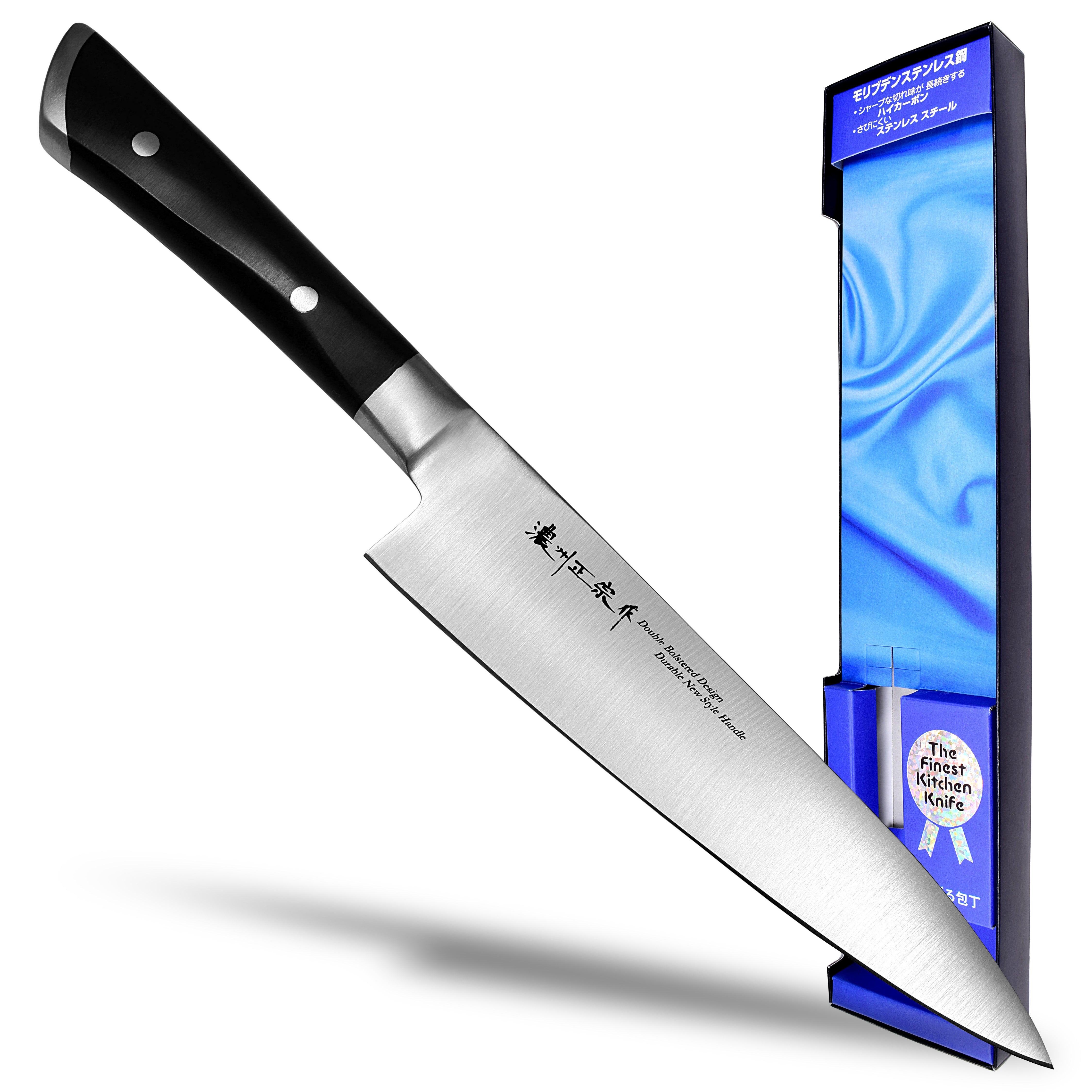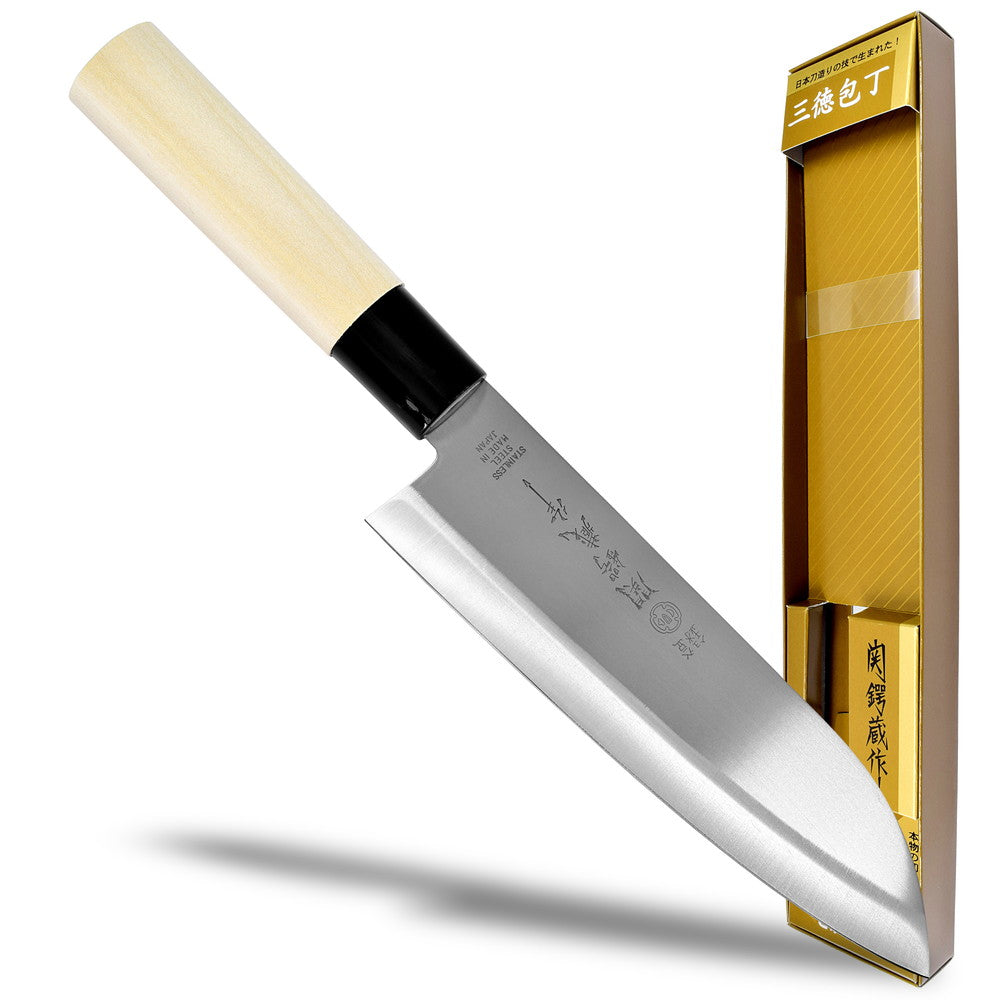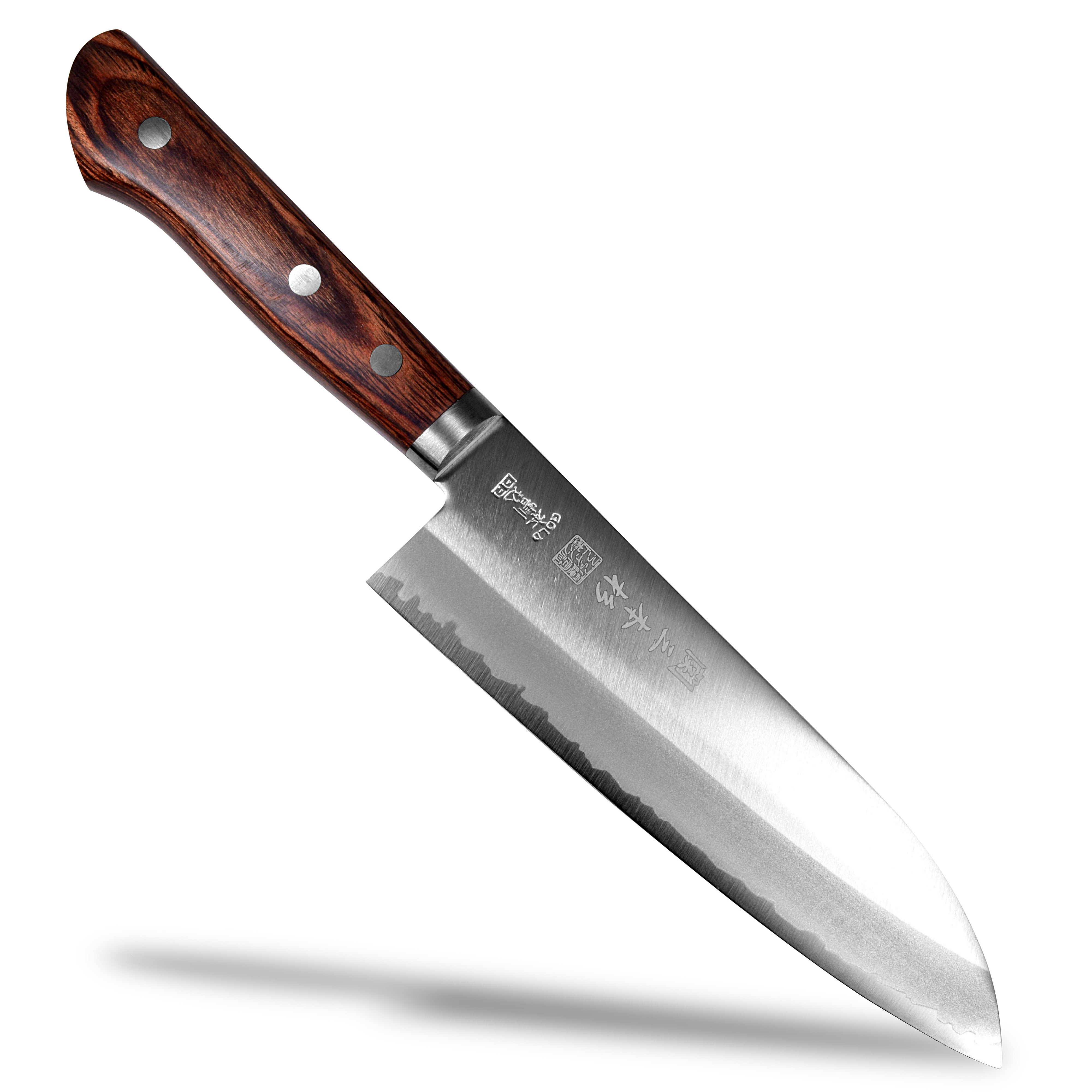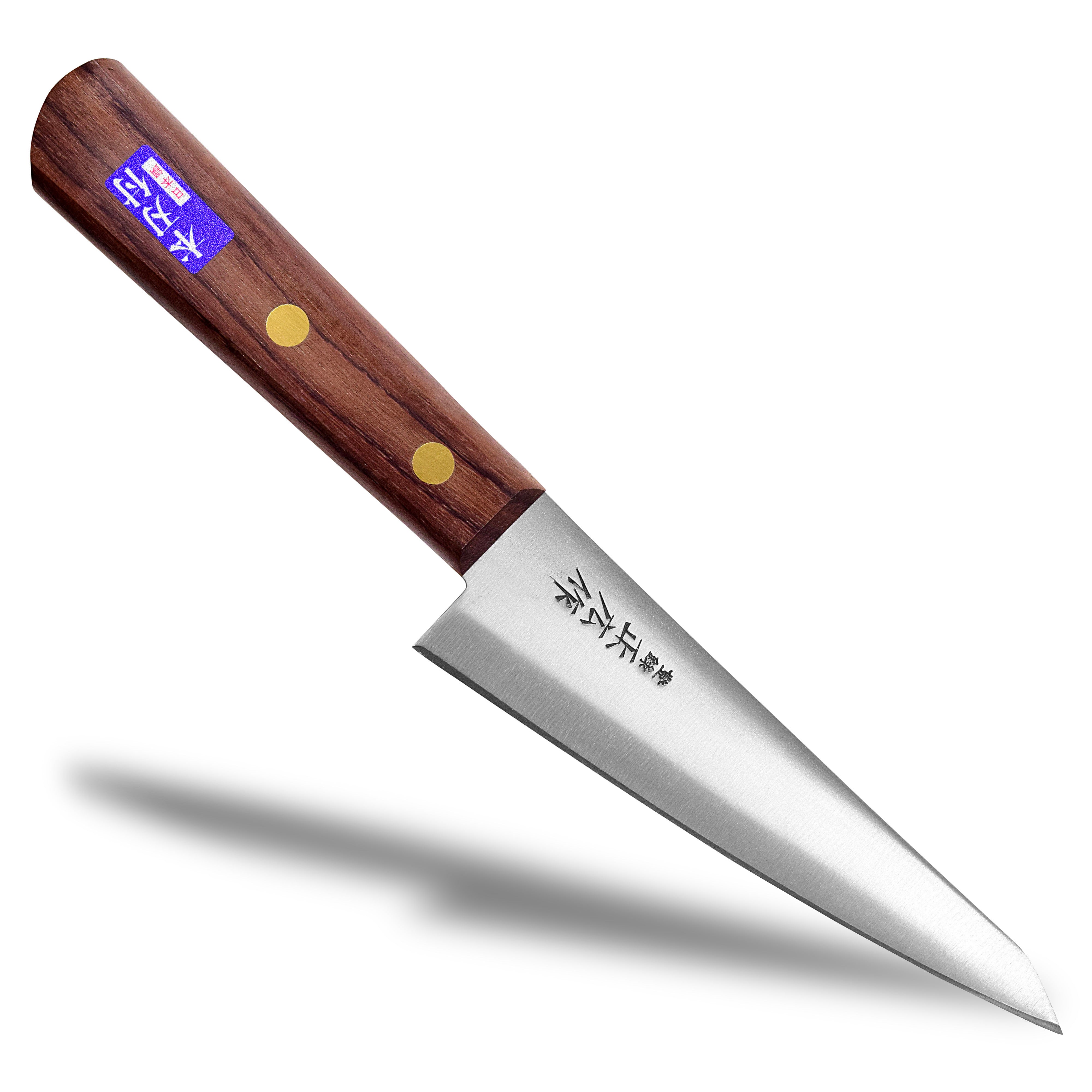

[Japanese Kitchen Knife Sharpening Stones for Beginners] How to Use and Use Sharpening Stones | Explanation of the Role and Sharpening Method of Each Type
For beginners using Japanese knives, the most important thing is to understand the role of each type of whetstone (coarse, medium, and finishing) and to follow a simple procedure: using the medium whetstone as the pivot point and moving it back and forth at a consistent angle. In short, the conclusion of this article is that "if you master the use of the medium whetstone, you can restore the sharpness of your Japanese knives at home."
The conclusion for beginners on how to sharpen Japanese knives at home using different types of whetstones and procedures is to "understand the role of each type of whetstone, focusing on medium-grit whetstones, and sharpen them at a consistent angle and in a specific order."
[Key points of this article]
The basic order for sharpening a Japanese kitchen knife is "coarse whetstone → medium whetstone → finishing whetstone," but for beginners, using only a medium whetstone is sufficient.
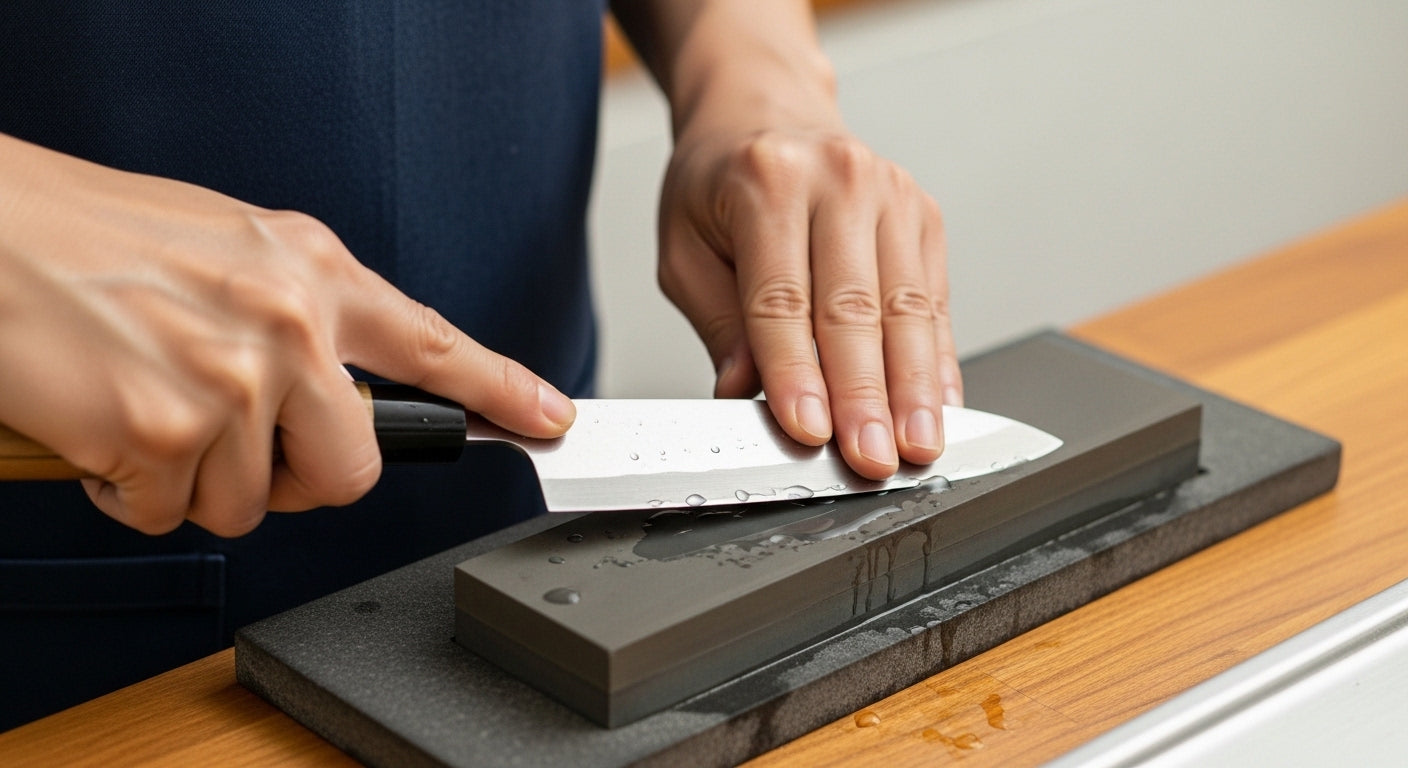
Using a whetstone is easy if you remember these four steps: "Soak the whetstone in water → Stabilize it → Sharpen it back and forth at a constant angle → Check for burrs."
For beginners, it's recommended to start with a basic set including a medium-grit whetstone (around 1000 grit), a whetstone holder, and a flattening stone, and begin with monthly maintenance.
Today's review: 3 key points
For beginners learning how to use Japanese kitchen knives and whetstones, the first step is to master the technique of "maintaining the angle and creating a burr" using just one medium-grit whetstone.
Sharpening stones come in three types: coarse, medium, and fine. Coarse stones are used to repair chipped blades, medium stones to restore sharpness, and fine stones to improve smoothness.
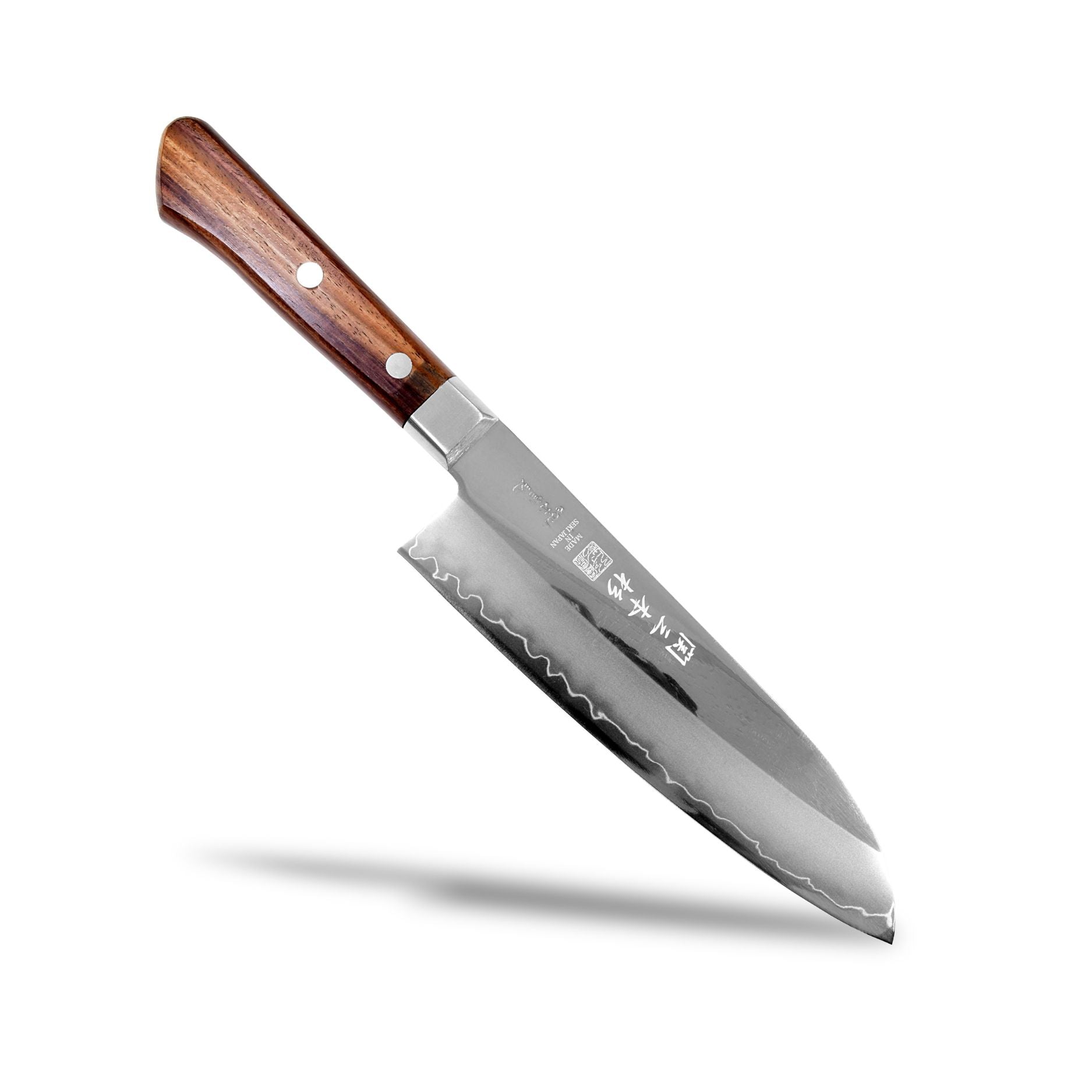
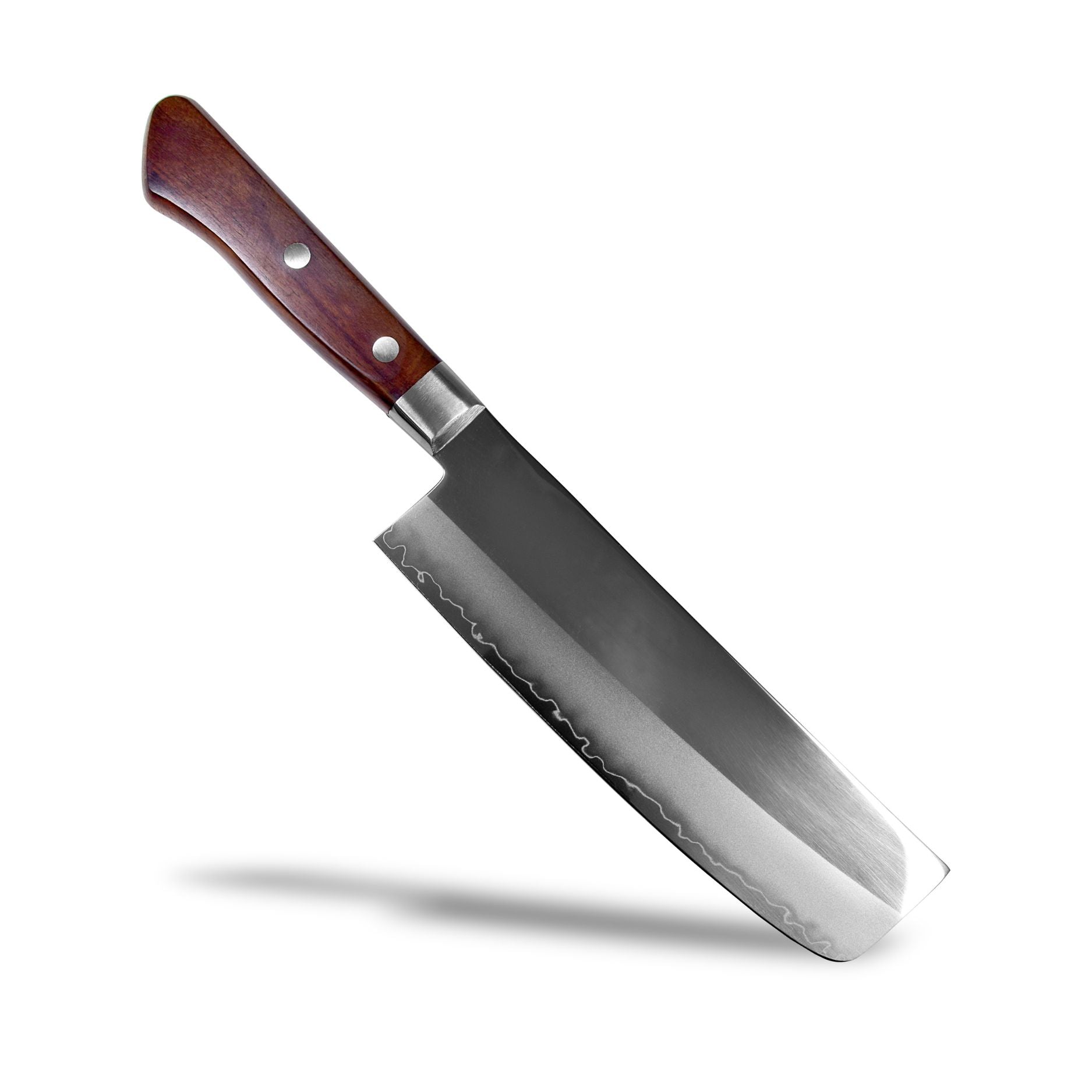
A good way for beginners to avoid mistakes is to start by practicing sharpening a double-edged santoku knife with a medium-grit whetstone.
Conclusion of this article
In conclusion, the most important thing a beginner in Japanese knife sharpening should learn is to "use a medium-grit stone, maintain a consistent angle, and create a burr across the entire edge of the blade."
For beginners learning how to use Japanese kitchen knives and whetstones, the key is to understand the role of each type of whetstone and start with a two-step process: medium whetstone → finishing whetstone.
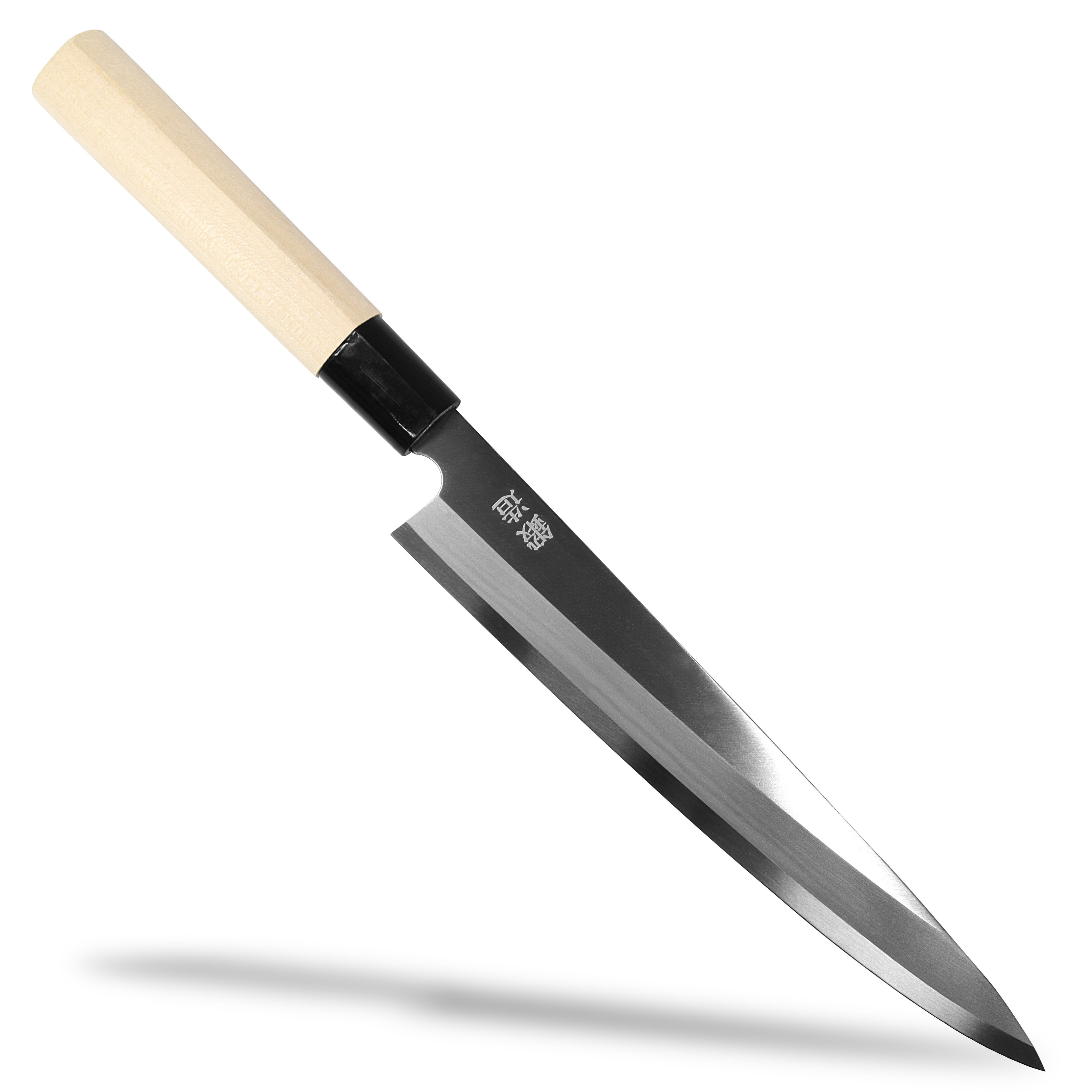
To avoid confusion, use a coarse whetstone only when the blade is chipped, a medium whetstone for daily maintenance, and a finishing whetstone for finishing delicate Japanese knives such as those used for sashimi.
What types of whetstones are necessary for beginners using Japanese kitchen knives?
In conclusion, the first whetstones a beginner in Japanese knife sharpening should acquire are one or two medium-grit whetstones, around 1000 grit. The reason is that, for both professionals and home users, the medium-grit whetstone plays the role of restoring lost sharpness, and coarse whetstones and high-grit finishing whetstones can be added later once you've gained experience. Specifically, if you're sharpening a santoku knife or a small Japanese knife at home, the best balance of cost-effectiveness and practicality is to choose either a single medium-grit whetstone or a double-sided whetstone with both a medium and a finishing whetstone.
What are the differences between coarse, medium, and fine whetstones?
In short, different types of whetstones are categorized by their grinding power and the fineness of the finish they produce. Coarse whetstones (around #80 to #400) are used to repair chips in the blade and to roughly shape the blade, while medium whetstones (#800 to #1200) are considered standard whetstones for restoring a dull blade to a usable level. Finishing whetstones (#3000 and above) are used to further smooth the edge that has been shaped with a medium whetstone and are often used for Japanese knives such as yanagiba and usuba knives for sashimi, where the beauty of the cross-section of the food is important.
Recommended whetstone materials and grit sizes for beginners
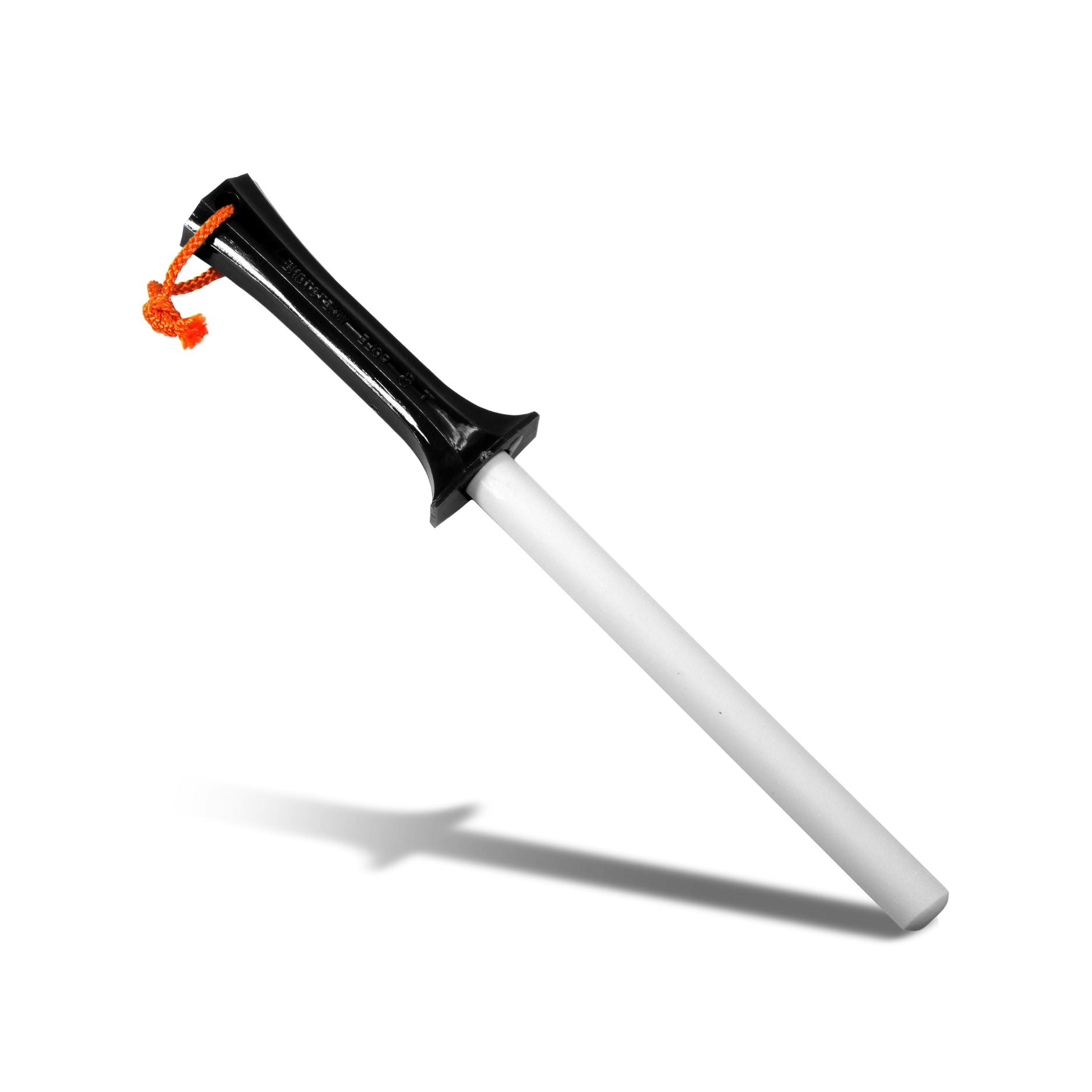
The most important thing, especially for beginners, is to choose a whetstone with an easy-to-handle grit and material. Knife manufacturers recommend a medium grit #1000 artificial whetstone (such as a ceramic whetstone) for first-time users, explaining that it is easy to understand the grit and is reasonably priced, and that it is suitable for both stainless steel and steel Japanese knives. For example, a medium grit whetstone with a base, about 18-21 cm in length, is often chosen for home use, and models with guides to assist with the sharpening angle are also available for beginners.
Should I use different whetstones for different types of Japanese knives?
In conclusion, for most households, using the same medium-grit whetstone to sharpen all types of Japanese knives is perfectly fine. However, if you frequently use Japanese knives made of harder steel, such as yanagiba or deba knives for sashimi, choosing a ceramic-based medium-grit whetstone with high abrasive power or a durable vitrified whetstone will shorten sharpening time and result in a more consistent finish. In any case, rather than suddenly acquiring multiple whetstones specifically for Japanese knives, it's a more practical step for beginners to first get a feel for sharpening each type of knife with just one medium-grit whetstone.
What are the different types of Japanese kitchen knives and how do beginners use them/follow the instructions?
In conclusion, beginners using Japanese knives will find it easy to learn how to use a whetstone by following these six steps: "Prepare the whetstone → How to hold the knife → Determine the angle → Sharpen the front side → Sharpen the back side → Remove the burr." This is because knife manufacturers and kitchenware manufacturers also base their explanations on this flow, and learning the steps separately makes it easier to identify where you are getting stuck. For example, when sharpening a santoku knife with a medium-grit whetstone, if you proceed for a few minutes per step, you can experience the entire sharpening process in about 20-30 minutes, even on your first try.
Preparation and setup of the whetstone
In short, the first hurdle is to "soak the whetstone thoroughly in water and secure it so it doesn't move." Many artificial whetstones need to be soaked in water for 10 to 30 minutes before use to allow water to penetrate the inside of the whetstone, while some ceramic whetstones can be used with just a short soaking or a quick rinse of water on the surface. Placing a dedicated whetstone stand or a damp cloth under the whetstone and securing it on the workbench to prevent it from moving will make it easier for beginners to maintain a stable sharpening angle.
Tips on blade angle and movement
The first thing beginners should focus on is maintaining a consistent blade angle. Many guides suggest placing the knife at a 45-degree angle to the whetstone, aiming for a blade angle of approximately 15-20 degrees. In practice, imagining the back of the knife being about the height of a stack of 1-2 yen coins makes it easier to find the right angle. Sharpening the entire blade evenly is achieved by dividing it into 3-4 sections—the tip, middle, and base—and moving the knife back and forth in a consistent rhythm.
Checking the return process and finishing points
In conclusion, the ability to "feel the burr" is the key to mastering the use of a whetstone. A burr is a very small "fine curl" that forms on the opposite side of the blade when one side has been sharpened sufficiently. You can feel it by gently running your fingertip over it. Once burrs have formed on both sides, lightly touch the blade to newspaper or cork to remove the burrs, and then, if necessary, lightly sharpen it a few times with a finishing whetstone at the same angle and with the same pressure to achieve a smooth edge.
How to choose a whetstone that's less likely to cause problems for beginners using Japanese knives, and what are some common mistakes?
In short, the best way for beginners to avoid mistakes when sharpening Japanese knives is to "not be too picky about whetstones and not rush into starting with a coarse whetstone." Many user examples suggest that using one general-purpose medium whetstone for extended periods is more effective in improving sharpening skills and extending the life of your knives than starting with expensive, professional-grade natural whetstones or extremely high-grit finishing whetstones. This article summarizes common mistakes beginners make and how to avoid them from the perspective of Japanese knife types, whetstones, and how to use them as a beginner.
Common mistake #1: The blade wears down too much because the grit size is wrong.
The most common mistake is "continuing to sharpen with only a coarse whetstone, causing the blade to wear down more than necessary." Coarse whetstones have very strong abrasive power, so they are not suitable except when the blade is severely chipped or rusted, and using them for daily maintenance will shorten the life of the blade. Beginners in Japanese knife sharpening should generally start with a medium whetstone of around 1000 grit, and only use a coarse whetstone partially in conjunction with it when the sharpness cannot be restored otherwise.
Common mistake #2: The angle is unstable and the sharpness doesn't return.
Another common mistake is the situation where "the angle changes every time, and no matter how much you sharpen, it doesn't cut." This is because the height of the blade when placed on the whetstone surface is not consistent, so a burr never forms, and in many cases, even though you think you are sharpening, the force is not reaching the tip of the blade. To stabilize the sharpening angle, sharpening guides that attach to the back of the knife and angle assist tools made by whetstone manufacturers are commercially available, so it is effective for beginners to use these auxiliary tools.
Common mistake #3: Forgetting to maintain the whetstone causes it to lose its flat surface.
It is often said that "no matter how skilled you are, you won't be able to sharpen properly if you can't keep the whetstone flat." When you continue to sharpen knives, the center of the whetstone becomes concave, and only a part of the blade of the Japanese knife makes contact, causing uneven sharpening and inconsistent cutting performance. As recommended by various manufacturers, you can extend the lifespan of your whetstone and maintain its sharpness by regularly flattening the surface with a whetstone flattening stone or a dedicated sharpening stone, and after use, rinsing off the abrasive residue with running water and then air-drying it in the shade.
FAQ
Q1. What type of whetstone should a beginner using a Japanese kitchen knife start with?
A1. The basic approach is to choose one whetstone with a grit of around 1000, as it is the most versatile tool for restoring sharpness.
Q2. What is the correct procedure for using a whetstone?
A2. The basic process is to immerse the whetstone in water to fix it in place, then sharpen the surface at a constant angle, then sharpen the back side, remove any burrs, and finish with a finishing whetstone.
Q3. Is it okay to start sharpening with a coarse whetstone?
A3. Unless the blade is severely chipped or rusted, starting with a medium-grit whetstone is recommended for beginners as it minimizes wear on the blade.
Q4. What is a good guideline for the sharpening angle of a Japanese kitchen knife?
A4. It is recommended to place the knife at an angle of about 45 degrees to the whetstone, and to maintain a consistent blade angle of around 15 to 20 degrees.
Q5. What should I do if I don't understand the return route?
A5. A burr is a small "flick" that forms on the opposite side of the blade tip, so the key is to gently trace it with the pad of your finger and continue sharpening the same spot until you feel a catch.
Q6. How often do whetstones need to be maintained?
A6. After each use, rinse off the grinding slurry with running water, and after sharpening a few times, use a flattening stone to create a smooth surface. This will help maintain a consistently stable sharpening feel.
Q7. Is it better to use separate whetstones for Japanese and Western-style knives?
A7. A general-purpose whetstone can be used for this purpose, but if you frequently sharpen hard steel Japanese knives, it will be more efficient to have a separate, more durable whetstone.
Q8. How long does it take to sharpen something using a whetstone?
A8. For beginners sharpening a santoku knife with a medium-grit whetstone, the process from preparation to finishing should take approximately 20 to 30 minutes.
Q9. Which is better suited for Japanese knives, a sharpener or a whetstone?
A9. While sharpeners are convenient, adjusting the blade shape is difficult, and sharpening with a whetstone is recommended if you want to bring out the original sharpness of a Japanese kitchen knife.
summary
The conclusion regarding the types of Japanese knives, whetstones, and how to use them as a beginner is to first prepare one medium-grit whetstone (around 1000 grit) and master the basic technique of "maintaining a consistent angle and creating a burr."
It's important to use a coarse whetstone for repairing chips in the blade and a finishing whetstone for fine-tuning the sharpness, following the "role of each type of whetstone + the correct order" when using them.
By maintaining the whetstone itself, including keeping it flat and managing its drying, you can achieve consistent sharpening results at home and continue using your Japanese knives comfortably for a long time.