
[Japanese Kitchen Knife Sharpening Techniques: Intermediate Level] Aim for the next level with proper whetstone management, angle, and burr removal.
The reason why intermediate-level Japanese knife sharpeners often struggle to improve is that they repeatedly sharpen knives without properly managing the whetstone's condition, applying consistent angle and pressure, and properly handling the back of the blade and the burr. In conclusion, keeping the whetstone flat at all times, sharpening evenly from the base to the tip of the blade at a consistent angle and pressure, and finally carefully handling the back of the blade and the burr is the quickest way to master a higher level of Japanese knife sharpening.
This guide provides a comprehensive explanation of how to sharpen Japanese kitchen knives, including information on whetstones and tips for intermediate users, aimed at those who want to take their skills to the next level.
In conclusion, for intermediate-level sharpeners who have become accustomed to sharpening Japanese knives, it is important to be mindful of three points to ensure consistent results: "whetstone maintenance," "sharpening angle and pressure," and "backside and burr treatment." Intermediate-level sharpeners, because they "can sharpen somehow," tend to develop their own methods, and small habits begin to manifest as differences in sharpness and edge retention. Now that you have graduated from the beginner stage, the key to the next step is to shift from relying solely on feel to managing the condition of the whetstone and blade with numbers and procedures.
[Key points of this article]
Today's review: 3 key points
- There are three key points for intermediate-level users when sharpening Japanese knives: "Always keep the whetstone flat," "Maintain a consistent angle and pressure," and "Carefully treat the back of the blade and the burr."
- Sharpening stones tend to become concave in the center with each use, and if you neglect to flatten the surface, the blade will become rounded and the sharpness will not be consistent.
- By dividing the blade into sections—the base, middle, and tip—and sharpening each section with the same number of strokes and pressure, it becomes easier to achieve a uniform finish similar to that of a professional.
Conclusion of this article
- In conclusion, for intermediate-level users aiming to improve the finish of their Japanese knives through sharpening, the shortest route is to thoroughly implement these three points: "always keep the whetstone flat," "maintain a consistent sharpening angle and pressure," and "carefully treat the back of the blade and the burr."
- In short, rather than increasing the sharpening time, "managing the condition of the whetstone and blade before and after sharpening" will lead to a higher level of sharpness and a consistent finish.
- The most important thing is to become aware of common habits among intermediate users, such as "leaving the whetstone indented," "using different angles each time," and "leaving burrs on the blade," and to make checking these points a routine.
- The difference between beginners and intermediate players lies not in intuition, but in whether they can control the "role, angle, number of uses, and face adjustment for each club" using numerical values and procedures.
What are some common mistakes intermediate users make when sharpening Japanese kitchen knives, particularly regarding whetstones?
In conclusion, the most common oversights by intermediate sharpeners are the failure to flatten the whetstone and the resulting unevenness of the blade due to using only the center of the whetstone. Whetstones gradually become concave as you sharpen, and the center wears down particularly quickly. If you continue sharpening in this state, the blade will become rounded, and no matter how much time you spend sharpening, it won't cut cleanly. Maintaining the condition of the whetstone may seem insignificant, but as long as you neglect this, you won't be able to achieve a consistent finish no matter how much your sharpening technique improves. If you think of "preparing the whetstone as preparing the blade," the hurdle of flattening the whetstone will become less daunting.
What happens if you don't keep your whetstone flat?
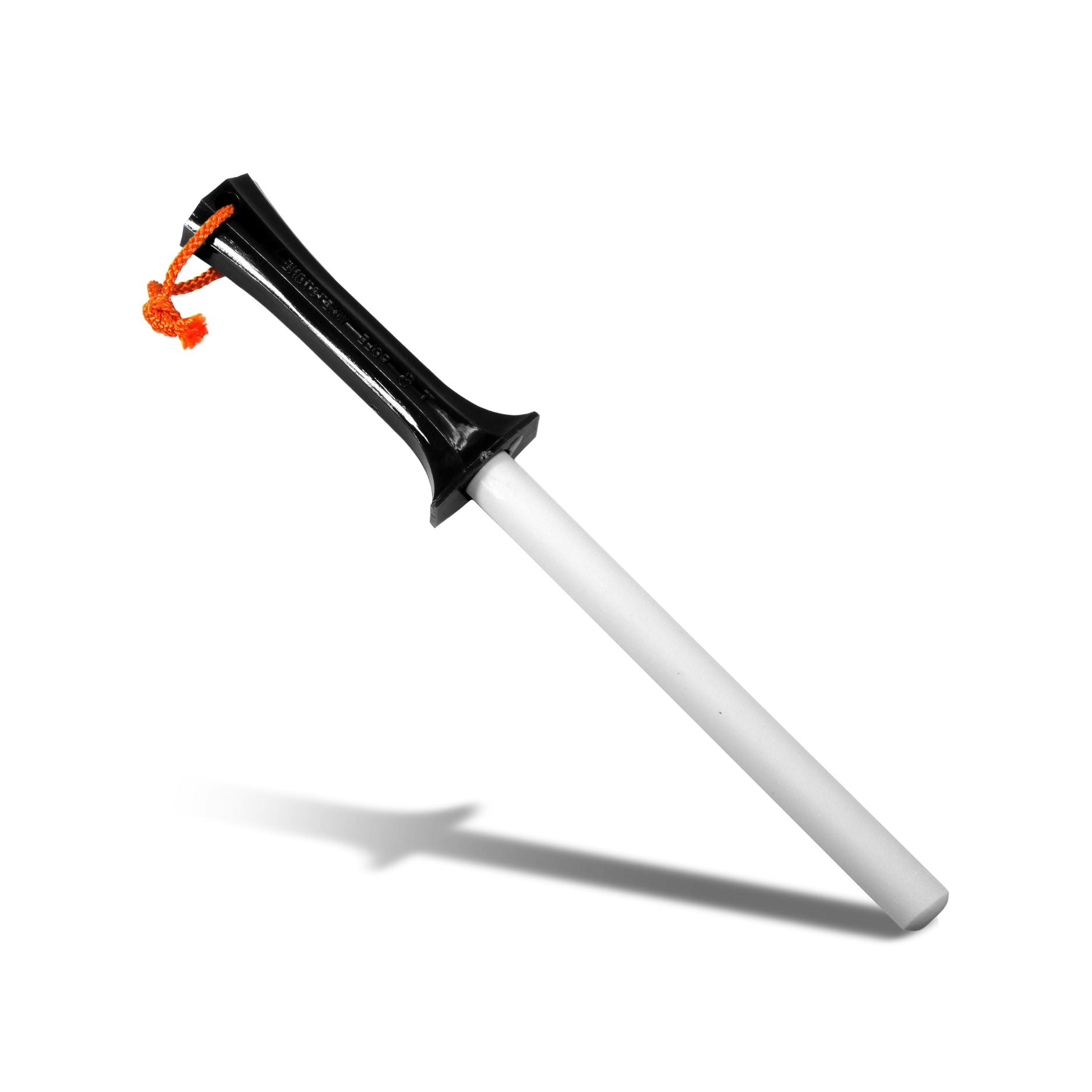
If you sharpen with a concave whetstone, the blade edge won't make even contact with the whetstone, resulting in a rounded edge where only the center is worn down, causing the point of contact with the cutting board to be uneven and food to slip easily. In short, many of the problems you encounter, such as "no matter how much I sharpen, the blade doesn't get any sharper" or "the blade quickly becomes dull," are caused by a concave whetstone. The first thing intermediate sharpeners should focus on is making it a routine to frequently flatten the surface of the whetstone before and after sharpening using a correction stone or coarse whetstone. By making flattening a habit, the precision of the sharpening itself will improve, and the inconsistency of "for some reason, it's not working out today" will be greatly reduced. Also, even inexpensive correction stones work well for flattening, so it's a good idea to have one along with your whetstone set.
Is it dangerous to sharpen using only the edge of the whetstone?
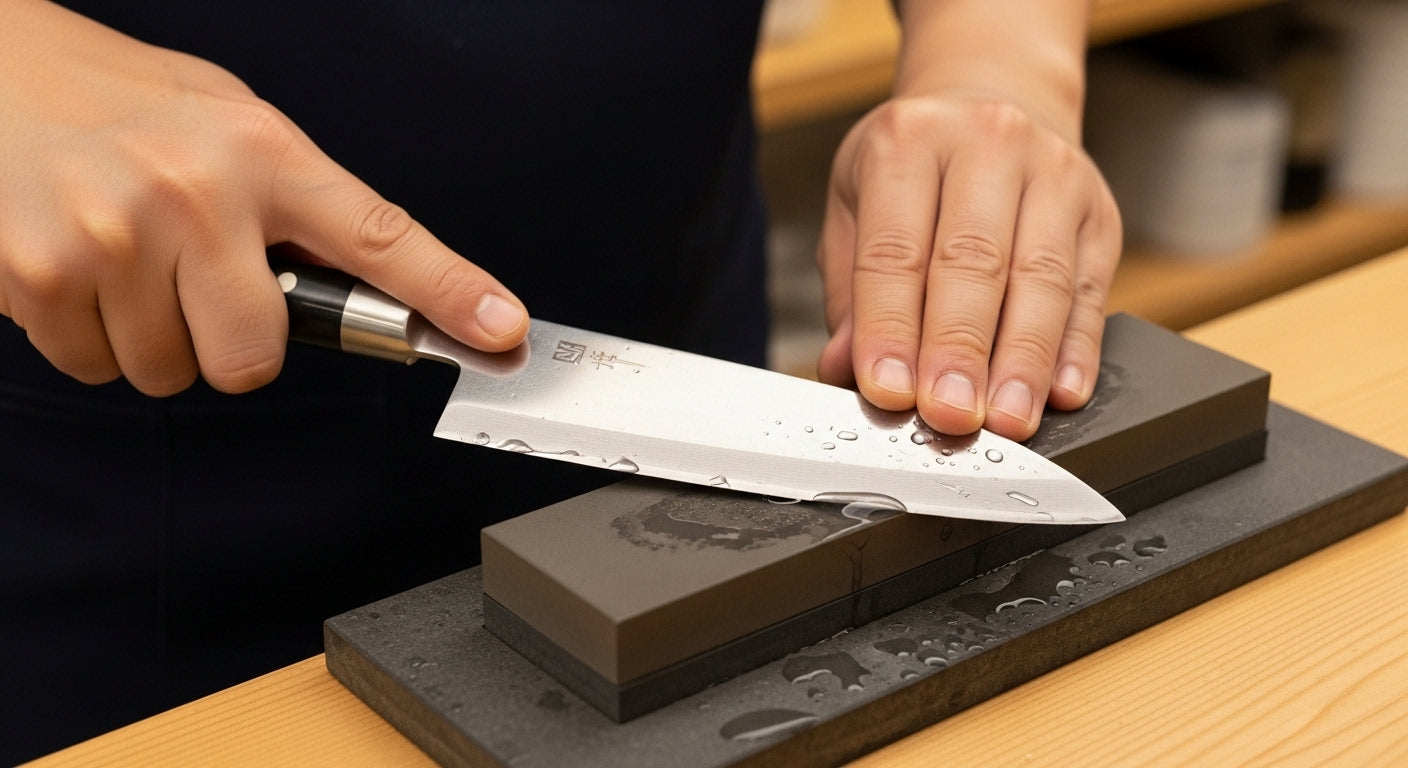
If you develop the habit of sharpening only on the edge of the whetstone, not only will one part of the blade be worn down too much, but the risk of the knife slipping off the whetstone during sharpening and causing injury will also increase. By using as much of the whetstone's vertical width as possible, and mainly using the center to slightly towards you, it becomes easier to maintain a stable posture. Single-edged Japanese knives, in particular, are often sharpened at an angle, so it is important to be careful not to use the very edge of the whetstone, as the corner can easily catch and lead to chipping of the blade. By placing the whetstone in front of your body and bending both elbows slightly along your body, you can easily use the entire whetstone and naturally develop a safe sharpening posture.
Sharpening stone grit and timing for flattening the stone
As a practical matter, even if you mainly use a medium grit (around #1000), it's ideal to flatten the whetstone surface after sharpening a few knives. Coarse and finishing whetstones change particularly quickly, so flattening the surface each time you switch grits will ensure consistent cutting performance at each stage. Simply adopting this habit can greatly reduce the common problem for intermediate sharpeners of "for some reason, today's sharpening isn't working." Coarse whetstones wear down quickly because they remove a lot of material, so making it a habit to always check the surface after use will allow you to start the next sharpening session with a whetstone in good condition.
What are the reasons why intermediate-level knives struggle to improve their sharpening techniques, and what are the key points for improvement?
In practical terms, for intermediate sharpeners who have reached the stage where they "kind of understand the angle" and "can feel the burr," even slight inconsistencies in angle, force, and number of strokes will make a difference in the final result. Here, we will outline the hurdles faced by intermediate sharpeners in Japanese kitchen knife sharpening and how to overcome them. Noticing and correcting small habits before your own style becomes ingrained is the most efficient route to achieving a consistent sharpness close to that of a professional.
Are the angle and force slightly different each time?
If you can't maintain a consistent sharpening angle, the blade edge can become too thick or, conversely, too thin and prone to chipping. Many intermediate sharpeners adjust the angle by "feel," but as they get tired, they gradually tend to tilt the blade too much, often unintentionally dulling it. The most important thing is to check the angle to the whetstone (approximately 15-20 degrees) using your own standard (such as the height of one or two coins) each time, and to fix the positions of your right and left hands to make it a routine. Just being conscious of keeping the angle the same at the beginning and end of sharpening will greatly reduce inconsistencies in the finish. It is also important to maintain a consistent amount of pressure; concentrate your "shaving" effort in the first half and switch to a "shaping" feeling in the second half to avoid applying unnecessary force.
Are you sharpening the base, middle, and tip of the blade the same number of times?
Because Japanese knives have long blades, if you don't consciously divide the blade into sections—the base, middle, and tip—and sharpen them accordingly, you're likely to end up with one part being over-sharpened or the tip being dull. Professional guides recommend dividing the blade into 3-4 sections and sharpening each section the same number of times (e.g., 10, 10, and 10 times), and this "number management" leads to a consistent finish. For intermediate sharpeners to improve, it's important to consciously repeat a certain number of strokes rather than relying on intuition, and to understand your own habits (such as neglecting the tip or applying too much pressure to the base). Creating a routine of sharpening the sections in the same order each time will reduce oversights and naturally improve the uniformity of the finish. The habit of checking the entire blade edge in the light after sharpening is also effective in discovering where the sharpening is uneven.
Is the back side sharpened too much or too little?
With single-edged Japanese knives, the handling of the back (back bevel) is especially crucial to the final finish. If you sharpen the back too much, the hollow on the back will disappear, causing the blade to stick to the cutting board. Conversely, if there are parts of the back that are not touching the whetstone, no matter how much you sharpen the front, those parts will not cut. Intermediate users should be mindful of minimizing the need for effective back beveling by "lightly touching the back with the final grit" and "checking that the whetstone is properly touching the entire edge of the back of the blade." There is no need to sharpen the back with the same force as the front; it is appropriate to gently place it on the whetstone and pass it over it a few times. If you feel that you have sharpened the back too much, consciously reduce the number of times you sharpen the back next time, and adjust the balance between the number of times you sharpen the front and back, and you will gradually achieve stability.
FAQ
Q1. How often should I resurface my whetstone?
A1. Ideally, you should sharpen the whetstone whenever you feel a depression in the center, but it's best to use a straightening stone to flatten it once after sharpening at least a few knives to ensure consistency.
Q2. If a knife doesn't cut even after sharpening, is the problem due to my skill or the whetstone?
A2. In most cases, the problem is largely due to technical issues such as "the whetstone is concave," "the angle is not consistent," or "the burr hasn't been completely removed," and it's not just a matter of the whetstone grit.
Q3. What are some points to keep in mind when an intermediate user uses a finishing whetstone?
A3. When using the finishing whetstone, the key is to use less pressure and fewer strokes, focusing on "smoothing out the burr," and to use it only after the shape has been fully formed during the coarse and medium whetstone stages.
Q4. What grade of whetstone should I use and to what extent should I sharpen the back side?
A4. With coarse and medium whetstones, keep the sharpening to a minimum, and with the final whetstone, lightly touch the entire back of the blade to remove the burr. This will allow you to maintain the back of the blade while stabilizing the sharpness.
Q5. What should I do if I don't understand what a burr looks like?
A5. Gently run your fingertip over the edge of the blade and check if you can feel any roughness on the other side. If it's difficult to feel, review each section to see if there are any areas that haven't been sharpened enough.
Q6. Do the points to keep in mind for intermediate users differ between Japanese and Western-style knives?
A6. The basics such as angle, pressure, and flatness control of the whetstone are common, but with single-edged Japanese knives, special attention must be paid to the back bevel and any unsharpened areas at the tip.
Q7. Are there any tips for maintaining a good finish even when shortening the sharpening time?
A7. By using coarse and medium grit whetstones to properly shape the blade and create a burr, and minimizing the number of times you use higher grit whetstones, you can easily achieve a stable sharpness without spending a lot of time.
Q8. What is a recommended whetstone set configuration for intermediate users?
A8. A three-stone configuration, centered around a medium-grit stone (around #1000), plus a coarse stone (#220-#400) for chipping and a finishing stone (#4000-#6000), is a good setup for achieving a consistent finish on Japanese kitchen knives.
summary
- For intermediate users aiming to improve the finish of their Japanese kitchen knives, the key lies in three points: "controlling the flatness of the whetstone," "stable angle and pressure," and "careful treatment of the back and burr."
- By always keeping the whetstone flat, sharpening the base, middle, and tip of the blade at the same angle and with the same number of strokes, and finally removing any burrs on the reverse side, you can more easily reproduce a consistent sharpness close to that of a professional.
- In conclusion, the quickest way to achieve a higher level of finish when sharpening Japanese knives is to shift your focus from "spending a lot of time" to "controlling the condition of the whetstone and the blade."